
Fasteners for Petrochemical Industry are mechanical components used to connect pipes, pressure equipment, structural supports, and plant machinery. Common examples include bolts, studs, nuts, screws, and washers. At a refinery flange, a stud and nut set helps hold gasketed faces together under specified operating conditions. Elsewhere, fasteners secure a pump base exposed to vibration, heat, moisture, or chemical splash. Small parts matter. Their failure can contribute to leaks, downtime, or costly inspection work.
Choosing them requires more than matching a thread size. Teams consider loads, temperature range, process exposure, joint design, installation method, and maintenance access. Material and coating choices must suit the actual service environment; one alloy is not ideal for every location. It is tempting to treat a corrosion-resistant label as a guarantee. It is not. Specifications, test records, and supplier traceability help confirm that supplied parts match project requirements. But documents cannot compensate for incorrect assembly or poor field inspection.
This guide explains what Fasteners for Petrochemical Industry include and why their selection deserves careful review. It also outlines common materials, applications, and checks that support reliable joints across plant operations. Actual requirements vary by equipment and service conditions, so project specifications and qualified engineering judgment remain essential.
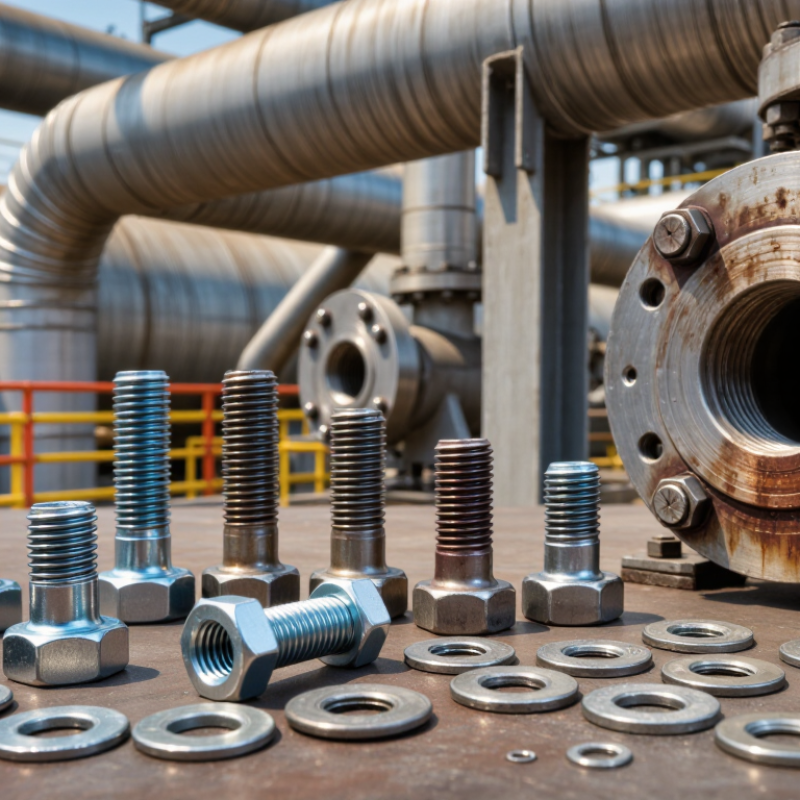
What Are Fasteners for the Petrochemical Industry?
What Petrochemical Industry Fasteners Are and How They Work
Petrochemical fasteners are bolts, nuts, and studs that hold equipment joints together under pressure, heat, vibration, and corrosive exposure. At a flanged pipe connection, tightening a stud stretches it slightly and creates clamping force across the gasket. That compression helps limit leakage as operating conditions change. Small parts. Large consequences. The IEA’s Oil 2024 report projects global oil demand will approach 106 million barrels per day by 2030. That outlook points to continued demands on processing and transport infrastructure, where dependable joints matter.
Material and installation choices determine how well a fastener performs. Engineers select grades and coatings to suit temperature, fluid chemistry, and the connected metals; a choice that works in one service may fail in another. Standards such as ASTM A193 cover alloy- and stainless-steel bolting for pressure and high-temperature service. ASME PCC-1 provides guidance for assembling bolted flange joints. Installers use specified tightening procedures because torque alone does not precisely reveal bolt tension. Lubrication, tool accuracy, and tightening sequence can all change the final clamp load. A drawing may look complete, yet actual service conditions can expose assumptions. That mismatch deserves review before installation.
| Fastener or assembly | Typical petrochemical use | Common material or specification examples | How it works | Key selection considerations |
|---|---|---|---|---|
| Stud bolts and nuts | Flanged pipe joints, pressure vessels, and process equipment | ASTM A193 Grade B7 studs with ASTM A194 Grade 2H nuts are common examples for many service conditions. | Nuts tension the studs, creating clamping force that compresses the gasket between flange faces. | Confirm design loads, temperature limits, flange and gasket requirements, corrosion conditions, and the specified tightening procedure. |
| Stainless steel bolting | Piping and equipment where corrosion resistance is required | ASTM A193 Grade B8M Class 2 bolts or studs and ASTM A194 Grade 8M nuts are examples of stainless bolting specifications. | The threaded fastener assembly applies and maintains clamping force; the alloy provides corrosion resistance suited to selected environments. | Stainless steel is not suitable for every chemical environment. Check the specific fluid, temperature, stress-corrosion risks, and compatibility of mating materials. |
| Low-temperature bolting | Equipment and piping designed for low-temperature service | ASTM A320 Grade L7 is one example of a bolting specification for low-temperature applications. | Bolts or studs provide joint clamping while the specified material properties address the design requirements at low temperatures. | Verify the required design temperature, impact-test requirements, nut specification, and project or equipment standard. |
| Anchor bolts | Securing tanks, vessels, pumps, and structural supports to concrete foundations | ASTM F1554 Grades 36, 55, and 105 are examples of anchor-bolt material grades. | The embedded portion transfers loads from the supported equipment or structure into the concrete foundation. | Select for tensile and shear loads, embedment, concrete design, installation method, and exposure to corrosion. |
| Hardened steel washers | Bolted joints where a specified washer is needed under a nut or bolt head | ASTM F436 covers hardened steel washers in specified types and dimensions. | A washer provides a bearing surface and helps distribute load; its use and type depend on the joint design. | Check the applicable bolting assembly requirements, dimensions, material, coating, and compatibility with the connected parts. |
| Bolting for sour service | Equipment exposed to environments containing hydrogen sulfide where sour-service requirements apply | Material selection may be governed by ISO 15156 / NACE MR0175 and the project’s specified requirements. | The fastener supplies the required joint load; material suitability and hardness controls help address the risk of sulfide stress cracking. | Assess the actual environment and applicable standard requirements. Do not assume a material grade is acceptable for every sour-service condition. |
Note: These are common examples, not universal recommendations. Final fastener selection, material pairing, installation, and inspection should follow the applicable design code, project specification, and service conditions.
They include bolts, nuts, and studs that hold equipment joints together under pressure, heat, vibration, and corrosive exposure.
Tightening stretches the stud slightly and clamps the gasket between flange faces. That pressure helps limit leaks as conditions change.
Engineers consider operating pressure, temperature swings, vibration, process chemicals, and the metals connected by the joint. Size alone is not enough.
No. Some environments can damage stainless steel too. Material compatibility needs checking for the specific service.
Lubrication, tool accuracy, and tightening sequence affect the force created by a given torque. The final clamp load may differ from expectations.
Check thread condition, flange alignment, and gasket placement. Keep fasteners clean and separated by size.
They help distribute the load evenly across the joint. A clean-looking joint can still be uneven.
Pause and request a qualified review. Guessing is worse, though stopping work can be inconvenient. Small details matter.
Fasteners for Petrochemical Industry are essential components that join pipes, vessels, pumps, and structural equipment in demanding process environments. They include bolts, nuts, studs, screws, and other fastening elements designed to create secure connections and maintain equipment integrity during operation. Their suitability depends on the joint design, installation method, and conditions the equipment must withstand.
Petrochemical facilities expose fasteners to pressure, elevated temperatures, vibration, moisture, and corrosive substances. Material and coating choices help protect against these conditions, while correct sizing and strength are needed for reliable performance. Selecting fasteners involves considering the equipment, operating environment, and applicable engineering requirements. Proper installation, including suitable tightening practices and inspection, helps maintain joint security and supports safe, dependable operation over time.