Call: +91 91723 33437 Email: [email protected] Address: Mumbai, India
Precision Titanium Stud Bolts Grade 2 Grade 5 manufactured by Stud Bolt India
ASTM F468 / B348 · ISO Certified · Mumbai Facility

High-Performance Titanium Stud Bolt Manufacturer & Engineering Global Supplier

The definitive technical solution for high strength-to-weight ratio, total immunity to marine chloride pitting, and zero-maintenance subsea, aerospace, and chemical pressure vessel bolting.

Exotic alloy fasteners and titanium stud bolt assemblies
Exporting to 24+ Countries worldwide

Engineered Titanium Fasteners for Extreme Environments

Ti Grade 2, Grade 5 (Ti-6Al-4V), Grade 7 & Grade 12 with EN 10204 3.1 certification and complete heat traceability.

Product Portfolio & Material Grades

Engineered Titanium Stud Bolt Solutions for Global Procurement

When severe chemical oxidation, seawater splash zone erosion, or dynamic aerospace vibration renders standard stainless steel or nickel alloys obsolete, engineered Titanium Stud Bolts deliver unmatched reliability. Manufactured in Mumbai and tested to strict ASTM F468, ASTM B348, and ASME B18.31.2 standards.

Titanium Grade 2 Stud Bolt ASTM F468
UNS R50400 · ASTM F468 Gr 2 · ASTM B348

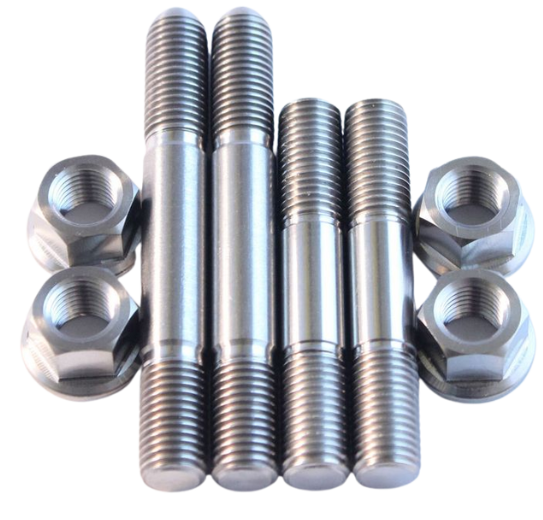
Titanium Grade 2 Stud Bolt

Commercially Pure (CP) Grade 2 titanium offers an ideal balance of moderate strength (min. 345 MPa yield) and outstanding ductility, combined with exceptional immunity to seawater pitting and nitric acid oxidation.

Titanium Grade 5 Ti-6Al-4V Stud Bolt
UNS R56400 · ASTM F468 Gr 5 · Ti-6Al-4V

Titanium Grade 5 Stud Bolt

The ultimate high-strength structural titanium alloy. Heat treated to achieve tensile strengths exceeding 895 MPa (130 ksi), replacing carbon steel and heavy duplex studs at nearly half the physical weight.

Titanium Grade 7 Stud Bolt UNS R52400
UNS R52400 · Ti-0.2Pd · ASTM F468 Gr 7

Titanium Grade 7 Stud Bolt

Alloyed with 0.12%–0.25% Palladium, Grade 7 delivers superior crevice corrosion resistance in reducing acid environments and high-temperature chloride solutions where Grade 2 reaches operational limits.

Titanium Grade 12 Stud Bolt UNS R53400
UNS R53400 · Ti-0.3Mo-0.8Ni · ASTM F468 Gr 12

Titanium Grade 12 Stud Bolt

Formulated with Nickel and Molybdenum for elevated temperature strength and superior resistance to crevice attack in hot brine, desalination evaporators, and chemical process piping.

Custom Flange Titanium Stud Bolts
ASME B16.5 · ASME B18.31.2 · Custom Threads

ASME Flange Titanium Studs

Continuous full-thread studs and double-end stud bolts custom sized for ASME B16.5 and B16.47 pressure vessel flanges, featuring rolled UNJ precision threads for enhanced fatigue life.

Anti-Galling Coated Titanium Stud Bolts
AMS 2488 Anodized · MoS2 Coated · Micro-Lubricated

Anti-Galling Titanium Studs

Engineered surface treatments including Type II anodizing, molybdenum disulfide solid film lubricants, and specialized nitriding to completely eliminate thread galling during high-speed torque installation.

Engineering Insight & Information Gain

Technical Mastery: Titanium Stud Bolt Metallurgy & Assembly Dynamics

Deep technical breakdown addressing real-world queries faced by EPC contractors, subsea design engineers, and global procurement leads.

Why Global Engineers Replace Super Duplex & Inconel with Titanium Stud Bolts

In high-salinity marine environments, chemical process reactors, and aerospace structures, selecting the optimal bolting material dictates equipment lifespan and operational safety. While Super Duplex Stainless Steel (UNS S32750) and Nickel Alloys like Inconel 625 provide high strength, Titanium Stud Bolts deliver two decisive metallurgical advantages: an unbeatable specific strength-to-weight ratio and instantaneous self-healing passive oxidation (Ti02 film formation).

Titanium possesses a density of approximately 4.51 g/cm³, which is nearly 45% lighter than alloy steel (7.85 g/cm³) and nickel superalloys (8.44 g/cm³). In offshore floating production storage and offloading (FPSO) units, subsea riser clamps, and satellite launch vehicles, every kilogram saved directly reduces structural load and operational costs. For instance, replacing 1,000 standard 1-3/8" ASTM A193 Grade B7 stud bolts with Titanium Grade 5 stud bolts cuts the total flange bolting mass from 4,200 kg down to under 2,360 kg without sacrificing tensile yield capability.

Chemical Composition & Mechanical Performance Comparison

To assist engineering teams in accurate RFQ spec verification, the table below details the metallurgical parameters across our primary ASTM F468 / ASTM B348 Titanium stud bolt grades:

Grade / UNS Designation Chemical Composition (%) Min Yield Strength 0.2% (MPa / ksi) Min Tensile Strength (MPa / ksi) Max Temp Rating Primary Engineering Environment
Titanium Grade 2
(UNS R50400)
Fe: 0.30 max, C: 0.08 max,
N: 0.03 max, O: 0.25 max, Ti: Bal.
345 MPa / 50 ksi 485 MPa / 70 ksi 300°C / 572°F Seawater cooling systems, chlor-alkali bleachers, wet chlorine gas, marine heat exchangers.
Titanium Grade 5
(UNS R56400 / Ti-6Al-4V)
Al: 5.5–6.75, V: 3.5–4.5,
Fe: 0.40 max, O: 0.20 max, Ti: Bal.
828 MPa / 120 ksi 895 MPa / 130 ksi 400°C / 752°F Subsea manifolds, aerospace airframes, offshore riser tensioners, high-vibration power turbines.
Titanium Grade 7
(UNS R52400)
Pd: 0.12–0.25, Fe: 0.30 max,
C: 0.08 max, O: 0.25 max, Ti: Bal.
345 MPa / 50 ksi 485 MPa / 70 ksi 350°C / 662°F Reducing acid solutions, hydrochlorides, dilute sulfuric acid, chemical process reactors.
Titanium Grade 12
(UNS R53400)
Mo: 0.2–0.4, Ni: 0.6–0.9,
Fe: 0.30 max, O: 0.25 max, Ti: Bal.
483 MPa / 70 ksi 586 MPa / 85 ksi 310°C / 590°F High-temperature brine evaporators, geothermal power plants, desalination reboilers.

Mitigating Thread Galling & Seizure in Titanium Assemblies

A frequent AI search query from mechanical technicians is: "Why do titanium stud bolts gall during tightening and how do we prevent it?" Titanium's natural tendency to gall stems from its ductile crystalline structure and high friction coefficient under contact pressure. When unlubricated titanium threads rub against titanium or stainless nuts under clamp load, localized micro-welding occurs, causing thread seizure.

At Stud Bolt India, we utilize a three-pronged engineering strategy to completely eliminate galling in field applications:

  • Precision Thread Rolling (UNJ Profile): Unlike traditional lathe-cut threads which create micro-burrs and torn grain boundaries, thread rolling cold-works the titanium surface, forming a smooth 0.4 Ra surface finish with continuous grain compression.
  • Surface Anodizing & Coatings: We provide Type II Titanium Anodizing according to AMS 2488 standards, creating an extra lubricious titanium dioxide surface layer. Molybdenum Disulfide (MoS2) dry film lubricant coatings can also be applied.
  • Dissimilar Nut Pairing: Pairing Titanium Grade 5 studs with anti-galling specialized aluminum-bronze or coated Grade 2 titanium nuts optimizes the sliding friction matrix and guarantees smooth torque-tension conversion.

Why Partner With Us

Manufacturer Expertise & E-E-A-T Quality Commitment

Stud Bolt India combines decades of practical metallurgy experience, certified manufacturing controls, and international supply chain agility to support global procurement teams.

EN 10204 3.1 Traceability

Every titanium stud bolt order is dispatched with complete Mill Test Certificates, chemical heat analysis, and physical test reports.

In-House PMI & Hardness Testing

100% Positive Material Identification via handheld XRF analyzers ensuring zero grade cross-contamination before threading.

CNC Machining & Cold Rolling

State-of-the-art CNC lathes and cold thread-rolling machines producing metric (M6–M100) and imperial (1/4" to 4") threads to exact tolerances.

Global Seaworthy Export Packing

Heavy-duty wooden boxes, individual thread protectors, and moisture-sealed vacuum wrap protecting your fasteners to 24+ countries.

Raw Titanium Bar

Verified ASTM B348 Grade 2 / Grade 5 titanium bars.

Precision Cutting

Automated band-saw cutting to specified stud lengths.

Thread Rolling

Cold-rolling UNJ or UNC/UNF thread profiles.

Surface Treatment

AMS 2488 anodizing or MoS2 dry lubricant application.

Final QC & Dispatch

EN 10204 3.1 certification and global export delivery.

Global Reach

Proven Track Record in Exotic Alloy Fasteners

0+
Satisfied Clients
0+
Metallurgical Experts
0+
Completed Projects
0+
Countries Exported
Applications

Industries Powered by Titanium Fasteners

From deepsea trenches to outer space, titanium stud bolts keep critical flange joints sealed tight.

Titanium stud bolts for marine and subsea applications

Marine & Subsea

Zero chloride pitting corrosion in splash zones, subsea risers, and offshore oil platforms.

Titanium stud bolts for aerospace industry

Aerospace & Defense

High strength-to-weight ratio for missile propulsion, jet engine mounts, and airframes.

Titanium stud bolts for chemical processing

Chemical Processing

Unmatched immunity to chlorine dioxide, wet gas bleachers, and nitric acid reactors.

Titanium stud bolts for oil and gas refinery

Desalination Plants

Long-term reliable performance in hot brine exchangers and high-pressure reverse osmosis pumps.

Engineering FAQ

Frequently Asked Questions on Titanium Stud Bolts

Direct, authoritative technical answers to top AI and engineering search queries.

What are the primary differences between ASTM B348 Grade 5 raw bar stock and ASTM F468 Grade 5 finished titanium stud bolts?
ASTM B348 is the standard material specification covering raw titanium and titanium alloy bars, billets, and forged stock. ASTM F468 is the comprehensive mechanical and dimensional specification for non-ferrous fasteners (bolts, stud bolts, and hex screws). While ASTM B348 defines chemical composition limits and raw bar tensile strength, ASTM F468 enforces proof load testing, thread pitch tolerances, wedge tensile requirements, hardness bounds, and anti-galling requirements specifically for completed pressure-retaining stud bolts.
How do engineers prevent thread galling during high-torque assembly of Titanium Stud Bolts?
Titanium has a high friction coefficient and a thin protective oxide layer that can tear under tightening friction, leading to severe thread seizure (galling). Galling prevention includes: 1) Specifying precision rolled threads instead of cut threads; 2) Applying specialized anti-seize lubricants like Molybdenum Disulfide (MoS2) or nickel paste; 3) Coating studs with Type II AMS 2488 titanium anodizing; and 4) Mating titanium studs with dissimilar metal nuts (e.g., Grade 2 titanium studs with lubricated aluminum-bronze or coated titanium nuts).
Can Titanium Stud Bolts be used directly in contact with stainless steel flanges without galvanic corrosion risks?
In dry atmospheric or mild environments, titanium and passive 316L stainless steel sit relatively close on the galvanic series scale, presenting low risk. However, in submerged marine or high-temperature electrolyte solutions, titanium acts as a noble cathodic metal. If attached to active, less noble metals, it can accelerate localized galvanic attack on the flange face. For subsea flange bolting, engineers utilize non-conductive dielectric flange isolation gaskets or apply protective barrier coatings.
What is the maximum continuous operating temperature for Titanium Grade 5 (Ti-6Al-4V) vs Grade 12 stud bolts?
Titanium Grade 5 (Ti-6Al-4V) retains high mechanical yield strength up to 400°C (752°F), above which thermal oxidation accelerates and stress-rupture life declines. Titanium Grade 12 (Ti-0.3Mo-0.8Ni) provides enhanced resistance to crevice corrosion in hot brine and acid media up to 300°C (572°F). For continuous service above 450°C, superalloys like Inconel 718 or ASTM A453 Grade 660 are recommended.
Why are thread-rolled titanium studs far superior to cut-thread titanium studs in dynamic fatigue applications?
Cold thread rolling compresses the grain structure of the titanium bar continuously along the thread profile without severing material fibers. This leaves beneficial compressive residual stresses at the thread roots, which increases resistance to fatigue failure by 300% to 500% compared to lathe-cut threads. Rolled threads are mandatory for critical aerospace, subsea riser, and high-vibration power generation assemblies.
What documentation and quality certificates accompany international shipments of Titanium Stud Bolts from Stud Bolt India?
Every export shipment is dispatched with full EN 10204 3.1 Material Test Certificates detailing optical emission spectrometry (OES) chemical breakdowns, heat treatment charts, tensile/yield/elongation mechanical results, PMI reports, and dimensional thread inspection sheets. Third-party inspection (EN 10204 3.2) by agencies like TUV, DNV, SGS, or Lloyd's Register is available upon request.

Need a Custom Titanium Stud Bolt Quote or Engineering Advice?

Speak with our Mumbai technical sales team today. We provide quick turnaround inquiries, material recommendations, and worldwide export delivery.