
Call: +91 91723 33437 Email: [email protected] Address: Mumbai, India
0%

Choosing the right Silicon Bronze Fasteners takes more than matching a screw to a hole. The service environment matters. Salt spray, damp timber, and frequent washing can all affect how a fastener performs over time. Silicon bronze is valued for its corrosion resistance and warm copper color, making it a common option for marine fittings, wooden boats, and outdoor joinery. Still, no alloy is ideal for every job.

A sound selection starts with the load, base material, and exposure conditions. Check the manufacturer’s specifications for alloy composition, dimensions, strength data, and applicable standards. Then consider the fastener style: a flat head may sit flush in a countersunk opening, while a pan head remains visible above the surface. Small details count. A mismatched driver can damage the head; an undersized pilot hole can split hardwood. In assemblies that combine different metals, review galvanic compatibility rather than assuming corrosion will not occur. That extra check is easy to skip.

This guide explains how to compare grades, sizes, head styles, and installation needs without treating a product label as a guarantee. It also highlights practical limits: silicon bronze may not suit every high-load application, and product properties can vary by manufacturer. When the consequences of failure are significant, consult current technical data or a qualified engineer. Careful choices begin with the real conditions—not just the fastener’s appearance.
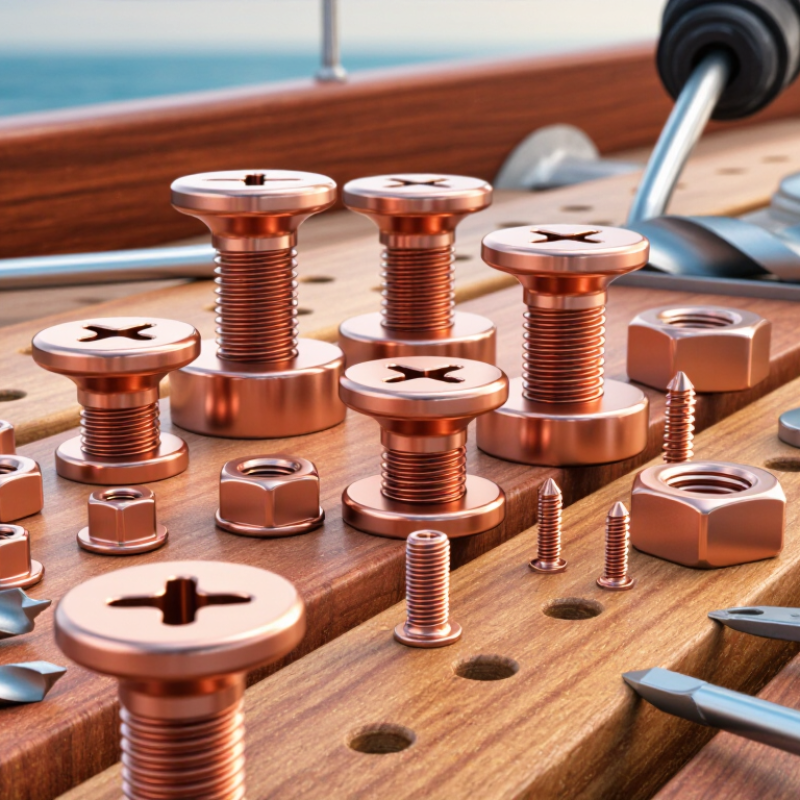
2026 How to Choose Silicon Bronze Fasteners

Define the Fastener’s Service Conditions and Required Joint Loads

Start with the fastener’s real service conditions, not its catalog description. Note whether the joint will face salt spray, rain, condensation, chemicals, heat, or frequent temperature changes. A dock fitting near seawater has a different exposure from a dry interior bracket. Record the contacting materials too; galvanic behavior depends on the metals, moisture, and their relative exposed areas. Small details matter.

Define the loads the joint must carry. Separate steady tension from shear, and account for vibration, impact, and repeated loading where relevant. A sign bracket may see modest weight but substantial wind-driven movement. Include prying forces and uneven support, which can raise stress around the fastener. Do not infer capacity from diameter alone. Alloy, thread engagement, fastener geometry, and the joined material all matter.

Check the expected clamp load and the joint’s allowable limits against reliable engineering data for the specific silicon bronze grade and condition. Avoid applying a generic torque value without confirming its basis; friction, lubrication, and surface finish can change the resulting preload. For critical or cyclic joints, have the design reviewed by a qualified engineer. I would not treat a dry indoor test as proof of outdoor durability; it can miss corrosion and loosening that emerge only after months of service.

Identify C65500 Alloy Chemistry: 2.8–3.8% Silicon per ASTM B98

When choosing silicon bronze fasteners, verify the alloy—not just the color or product description. C65500 contains 2.8–3.8% silicon under ASTM B98. That range is a useful identification point, but chemistry alone does not confirm a fastener’s strength, dimensions, or suitability for a specific joint. Ask for material test documentation that names the alloy and reports its measured composition. Small paperwork details matter.

Silicon helps strengthen the copper-based alloy and supports useful corrosion resistance in many settings. Still, the exact service environment matters. Salt spray, dissimilar metals, temperature, and sustained loads can change how a fastener performs. Check the applicable product specification and design requirements, especially when a rod or bar is machined into a fastener. I would not assume that every item sold as “silicon bronze” has identical properties. Labels can be imprecise.

Tips: Compare the certificate’s silicon value with the 2.8–3.8% range. Confirm the stated standard and alloy designation. Keep the documents with the installation record. If the chemistry is near a limit, pause and verify the test method and lot identification; that extra check may feel fussy, but it can prevent a costly mismatch.

2026 How to Choose Silicon Bronze Fasteners — Identify C65500 Alloy Chemistry: 2.8–3.8% Silicon per ASTM B98

Use the alloy designation and material certificate to confirm composition. ASTM B98/B98M covers copper-silicon alloy rod, bar, and shapes; it is not, by itself, a finished-fastener product specification.

C65500 chemistry and fastener-selection reference
Check or dimension Requirement or reference How to use it when choosing fasteners
C65500 alloy chemistry — composition by weight
Silicon (Si) 2.8–3.8% Primary chemistry identifier for C65500. Check the reported heat analysis against the applicable specification and certificate.
Manganese (Mn) 0.5–1.3% Confirm the reported value falls within the specified range; do not identify the alloy by silicon content alone.
Iron (Fe) 0.8% maximum Compare the certificate value with the applicable composition limit.
Zinc (Zn) 1.0% maximum Review alongside the other alloying-element limits when verifying grade.
Lead (Pb) 0.05% maximum Check the material certificate for the reported value and the applicable specification limit.
Copper (Cu) 96.0% minimum Copper is the balance of the alloy, subject to the specified limits for other elements.
Units and basis Percent by weight Confirm that chemistry results and limits are expressed on the same basis.
Practical fastener selection checks
Material identity UNS C65500; request traceable material documentation Look for the alloy designation and heat or lot traceability on the certificate. A color match or marketing description is not proof of grade.
Product-form specification Check the cited ASTM B98/B98M edition and the material form supplied B98/B98M covers rod, bar, and shapes. Confirm separately that the finished fastener’s product requirements, dimensions, and acceptance criteria are specified.
Fastener dimensions Specify diameter, length, thread form, pitch, and tolerance Match the fastener to the mating part and assembly drawing. Do not infer dimensional compliance from the alloy designation.
Mechanical requirements Specify the required strength, hardness, and test method for the finished product Request supporting test documentation where required. Mechanical properties depend on product form, processing, and condition; do not assume values from chemistry alone.
Service environment Assess exposure, temperature, loading, and contact with dissimilar metals Confirm suitability for the actual application. Corrosion performance can vary with environment and assembly details.
Thread and installation Check mating-material compatibility, engagement, and installation method Use the design’s specified torque or installation procedure; avoid substituting a generic value without engineering approval.
Final verification Compare purchase requirements, certificate, and inspection results Resolve differences in grade, specification edition, chemistry, dimensions, or test requirements before accepting the fasteners.

Note: Chemistry limits shown are a reference for C65500. Verify the current applicable ASTM B98/B98M edition and the supplier’s product-specific documentation before purchase or acceptance.

Select Fastener Type and Size Using ASME B1.1 Unified Thread Standards

For a silicon bronze fastener, read the thread callout before choosing a screw or nut. ASME B1.1 defines Unified inch thread forms, series, pitches, and fit classes; it does not specify the fastener’s material or head style. A callout such as 1/4-20 UNC-2A identifies a 1/4-inch nominal diameter, 20 threads per inch, a coarse thread, and a class 2A external thread. Its mating nut commonly uses a 2B internal thread. Check the callout.

Match the thread series to the job. Coarse threads are often practical for general assembly, while fine threads can suit applications needing smaller pitch increments. Confirm the diameter, pitch, and class against the drawing or parts list; do not rely on a bolt that merely seems to fit. Then choose the fastener type and length for the joint, clearance, and tool access. B1.1 does not determine those details. Silicon bronze properties can vary by product, so verify strength and installation guidance for the specific fastener. Small details matter. I would also recheck an old sample against the written specification: wear, coatings, or a hurried measurement can make a thread look right when it is not.

Verify Strength and Material Requirements Against ASTM F468

2026 How to Choose Silicon Bronze Fasteners

Verify Strength and Material Requirements Against ASTM F468

Silicon bronze fasteners suit many marine, outdoor, and electrical applications, but the alloy name alone does not confirm strength. ASTM F468 covers nonferrous bolts, hex cap screws, and studs for general use. Check that the fastener type and material grade fall within the specification’s scope.

Match the specified alloy and fastener dimensions to the applicable ASTM F468 requirements. Review the relevant mechanical-property limits, not just a general strength description on a sales sheet. Ask for material documentation that identifies the alloy and product lot, then compare it with the project specification. Confirm the standard’s edition and any additional requirements on the drawing or purchase order. Also consider the actual load, thread engagement, and service temperature. A compliant fastener may still be unsuitable for a particular joint. It is easy to overlook that distinction.

Tips: Check markings and paperwork before installation. If the grade or test data is unclear, pause and ask the supplier for clarification. Don’t assume every silicon bronze fastener meets ASTM F468.

Assess Galvanic Compatibility and Marine Exposure Using ASTM G82

2026 How to Choose Silicon Bronze Fasteners

ASTM G82 helps engineers compare metals by their galvanic behavior in seawater. It is a guide, not a service-life calculator. Check the exact alloys, not just labels such as “bronze” or “stainless.”

In a wet marine joint, silicon bronze fasteners connected to aluminum can accelerate aluminum loss. The risk grows when a small aluminum area is coupled to a much larger bronze surface. Salt deposits around a bolt head can keep the joint damp, even after visible spray dries.

Use ASTM G82’s galvanic series as a screening tool, then assess the real assembly: seawater or splash exposure, coating damage, crevices, and the exposed-area ratio. Consider insulating sleeves or washers where they suit the load and installation.

The NACE IMPACT study estimated global corrosion costs at US$2.5 trillion in 2013, or 3.4% of global GDP; that figure covers corrosion broadly, not fasteners alone.

Still, charts are imperfect. Potential rankings vary with water chemistry, temperature, and flow, so a table cannot promise a fixed failure date. Inspect a representative joint after exposure, especially where water can remain trapped.

FAQS

What service conditions should I check before choosing a fastener?

Record salt spray, rain, condensation, chemicals, heat, and temperature changes. A dock fitting faces different exposure from an indoor bracket. Small details matter.

Which loads should the joint be designed to carry?

Check tension, shear, vibration, impact, and repeated loading. Wind can move a sign bracket and add stress. Include prying forces and uneven support.

Does fastener diameter alone show whether it is strong enough?

No. Alloy, geometry, thread engagement, and joined materials all affect capacity. Diameter alone is not enough.

How can I verify C65500 silicon bronze chemistry?

Request material test documents identifying C65500 and its measured composition. ASTM B98 specifies 2.8–3.8% silicon. Check the lot details too.

Does a silicon bronze label confirm the fastener’s strength?

No. The label may not confirm grade, strength, or suitability. Compare documentation with the project requirements. Labels can be imprecise.

What should I check against ASTM F468?

Confirm the fastener type, material grade, dimensions, and relevant mechanical properties fall within the specification. Check the edition and project requirements as well.

Can I use a general torque value for installation?

Avoid doing so without confirming its basis. Friction, lubrication, and surface finish affect preload. I might be overly cautious, but guessing can misload a joint.

Is a dry indoor test enough to prove outdoor durability?

No. It may miss corrosion or loosening that develops over months. For critical or cyclic joints, seek qualified engineering review. A short test has limits.

Conclusion

Choosing Silicon Bronze Fasteners starts with understanding the joint’s service conditions, including expected loads, vibration, moisture, and exposure to saltwater or other corrosive environments. These factors help determine whether the fastener material and design are suitable for the application. For C65500 silicon bronze, confirm that the specified alloy chemistry aligns with ASTM B98, including its 2.8–3.8% silicon range, and select the fastener type and dimensions to suit the assembly.

Use the ASME B1.1 Unified Thread Standard to check thread form and sizing, then verify applicable strength and material requirements against ASTM F468. Also consider galvanic compatibility with adjoining metals and the level of marine exposure; ASTM G82 can inform evaluation of galvanic corrosion risks. Reviewing these requirements together helps support a reliable connection and a material choice suited to its operating environment.

Charlotte

Charlotte

Charlotte is a professional marketing specialist who brings a deep understanding of the company’s products and the needs of the people who use them. She regularly contributes expert articles to the company website, turning product knowledge and industry insights into clear, practical guidance. Her......