
Engineering Whitepaper: OEM/ODM Metric Threaded Rod Manufacturing Excellence, Metallurgical Standards & Global Procurement Strategies
In modern industrial engineering, heavy infrastructure, automotive power systems, and high-pressure chemical processing, the humble threaded rod serves as a critical load-bearing structural component. As global OEMs (Original Equipment Manufacturers) and ODMs (Original Design Manufacturers) transition toward high-stress, anti-corrosive, and high-precision mechanical assemblies, selecting the appropriate metric threaded rod supplier is no longer merely a purchasing transaction—it is a foundational risk-management decision.
1. Technical Fundamentals & Dimensional Specifications of Metric Threaded Rods
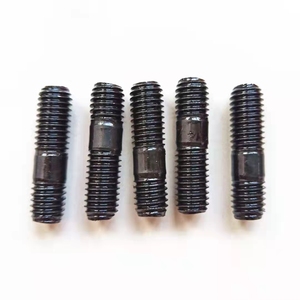
Threaded rods, also referred to as studding or continuous fully threaded bars, are designed to distribute tension across extended lengths or facilitate custom stud cut-to-length configurations. Unlike standard fasteners, metric threaded rods adhere strictly to the International Organization for Standardization (ISO) metric screw thread profile, defined by a 60-degree basic thread angle.
The structural integrity of a metric threaded rod depends upon three core parameters: pitch geometry, major/minor diameter compliance, and cold thread rolling grain orientation. When produced via high-speed thread rolling machines rather than subtractive metal cutting, the continuous grain structure of the steel wire rod remains unbroken, delivering up to a 20% increase in fatigue strength and improved yield performance.
Comparative Technical Specification Matrix: Metric Threaded Rod Grades & Engineering Properties
| Property Standard | Material Specification | Tensile Strength (MPa) | Yield Strength (MPa) | Elongation (%) | Recommended Industrial Applications |
|---|---|---|---|---|---|
| Class 4.8 | Low Carbon Steel (Q195 / Q235) | 400 | 320 | 14% | General Framing HVAC, Cable Trays, Light Construction |
| Class 8.8 | Medium Carbon Steel, Quenched & Tempered | 800 | 640 | 12% | Structural Duty Heavy Machinery, Automotive Sub-assemblies |
| Class 10.9 | Alloy Steel (4140 Cr-Mo) Quenched & Tempered | 1040 | 940 | 9% | High Stress Automotive Chassis, Heavy Mining Trucks |
| Class 12.9 | High Alloy Steel (4340 / 35CrMo) | 1220 | 1100 | 8% | Extreme Tension Wind Turbine Hubs, Hydraulic Presses |
| Grade A2-70 | Austenitic Stainless Steel (AISI 304) | 700 | 450 | 40% | Corrosion Resistant Food Processing, Architectural Fastening |
| Grade A4-80 | Austenitic Stainless Steel (AISI 316 / 316L) | 800 | 600 | 20% | Marine Grade Off-Shore Oil Rigs, Desalination Plants |
| ASTM A193 B7 | Chromium-Molybdenum Alloy Steel | 860 (min) | 725 (min) | 16% | High Temp/Pressure Petrochemical Flanges, Pressure Vessels |
2. OEM/ODM Customization Capabilities: From Raw Wire Rod to Finished Assembly
As a leading specialized factory for OEM/ODM metric threaded rods, advanced manufacturing capabilities extend far beyond standard 1-meter, 2-meter, or 3-meter stock lengths. OEM partners frequently require tailored mechanical specifications, non-standard pitch dimensions, specialized surface treatments, and pre-cut stud configurations with chamfered lead-ins.
Thread Pitch & Profile Tuning
Full capability to roll Coarse Pitch (DIN 975), Fine Pitch (DIN 976-1), Metric Extra-Fine Pitch, as well as dual-thread combination studs (Metric-to-UNC/UNF transitions) with 6g, 6h, or custom 4h6h high-precision tolerance classes.
Special Metallurgy & Superalloys
Beyond carbon and standard 304/316 stainless steels, our metallurgical capabilities encompass Duplex 2205, Super Duplex S32750, Inconel 625/718, Monel 400, Hastelloy C276, and Titanium Grade 5 (Ti-6Al-4V) for hyper-corrosive environments.
Advanced Surface Engineering
Engineered anti-corrosion barrier coatings including Hot-Dip Galvanizing (HDG to ISO 1461), Zinc-Nickel Plating (1000+ hrs salt spray to red rust), Electroless Nickel Plating, PTFE/Xylan 1424 fluoropolymer, and passivated oxide finishes.
Custom Mechanical Machining
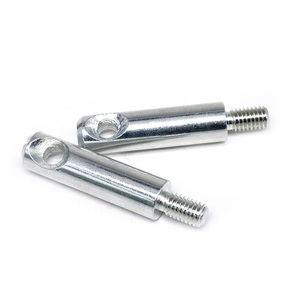
Secondary CNC machining operations including double-ended step-down thread reductions, cross-drilled cotter pin holes, unthreaded middle centers, custom wrench flats, dog points, and precision radius chamfering.
EN 10204 3.1 Traceability
Comprehensive quality documentation issued for every production batch: Spectro Chemical Analysis, Tensile & Proof Load Test Reports, Hardness Testing (Rockwell/Vickers), Charpy Impact Test data, and Microstructure Grain Examination.
Kitting & Export Packaging
Pre-assembled stud bolt packages complete with matching DIN 934 hex nuts and DIN 125 flat washers. VCI anti-rust paper wrapping, plastic thread protectors, and fumigated solid wooden export crates built for ocean transit.
3. Analysis of Global Fastener Procurement Trends (2025–2030)
The global market for metric threaded rods and industrial fasteners is undergoing a structural paradigm shift driven by stringent decarbonization mandates, smart automation, and risk-mitigated supply chain localization. Buyers across North America, Europe, and the Middle East are evaluating manufacturers through new lenses of sustainability, total cost of ownership (TCO), and automated quality inspection.
Key Sourcing & Technological Trends Shaping the Market:
- Low-Carbon Green Steel Manufacturing: Procurement policies within Tier-1 automotive and green building consortiums (LEED/BREEAM) increasingly prioritize fasteners crafted from scrap-recycled Electric Arc Furnace (EAF) steel with documented Carbon Footprint Declarations (EPD certification).
- Anti-Galling Coatings for Stainless Steels: Cold welding or galling during automated high-speed torque assembly of stainless steel (304/316) metric rods remains a primary cost driver. Next-generation dry-film lubricant coatings (such as molybdenum disulfide and specialized micro-encapsulated waxes) are replacing messy anti-seize pastes.
- Digital Twin Quality Verification: Leading OEM factories are implementing inline eddy-current flaw detection and optical laser sorting systems that continuously measure pitch diameter, thread lead angle, and surface micro-cracks at production speeds of 200 pieces per minute.
- Buffer Stock Management & VMI Programs: To insulate operations from global shipping disruptions, major industrial buyers are establishing Vendor-Managed Inventory (VMI) arrangements with trusted factory partners, requesting 60-day safety stock buffers maintained near destination ports.
4. Future Technological & Metallurgical Development Trends
As operating environments in aerospace, subsea oil exploration, and concentrated solar power (CSP) reach new extremes of temperature and pressure, the metallurgy of threaded rods must evolve accordingly. Future-proof factory production is centered on three core technological frontiers:
A. Advanced Quenching & Tempering (Q&T) Thermodynamics: Precision computer-controlled induction heat treatment lines prevent surface decarbonization—a primary cause of fatigue failure in Class 10.9 and 12.9 high-tensile threaded rods. By refining grain boundary structures to ASTM No. 8 or finer, impact toughness at sub-zero temperatures (e.g., -40°C to -101°C for ASTM A320 Grade L7) is significantly enhanced.
B. High-Entropy Alloy (HEA) Fasteners: Research into multi-principal element alloys is paving the way for next-generation threaded rods capable of maintaining yield strength above 800°C without undergoing thermal creep deformation or stress corrosion cracking.
C. Intelligent RFID-Embedded Fastening: For critical civil infrastructure (bridges, nuclear containment vessels, offshore wind platforms), smart threaded rods equipped with embedded micro-acoustic sensors or passive RFID tags enable non-destructive ultrasonic tension monitoring throughout the operating life of the bolt.
5. Enterprise Core Advantages & Quality Management Ecosystem
As a premier manufacturing enterprise with extensive export experience to over 24 countries, our integrated facility bridges the gap between raw material engineering and field performance reliability. Anchored by the rigorous principles of E-E-A-T (Experience, Expertise, Authoritativeness, and Trustworthiness), our factory operations guarantee seamless execution for custom OEM/ODM contracts.
Why Global EPC Contractors and OEMs Partner With Our Factory:
- Integrated Production Facility: From wire drawing, spheroidize annealing, and cold heading to high-speed thread rolling and heat treatment, every phase is controlled in-house to eliminate third-party quality variance.
- Strict Raw Material Sourcing: We source prime steel billets exclusively from audited tier-1 mills (accompanied by original EN 10204 3.1 mill test reports). Positive Material Identification (PMI) handheld XRF spectro-analysis is conducted on 100% of incoming raw material lots.
- Full Spectrum Testing Laboratory: Our in-house ISO 17025 accredited laboratory conducts tensile strength testing, proof load testing, Rockwell & Vickers hardness testing, salt spray corrosion testing (ASTM B117), and optical profile projection.
- Tailored OEM Branding & Packaging: Custom head markings, batch code stamping, barcode tracking tags, and private-label packaging tailored to distributor networks across North America, Europe, and Asia-Pacific.
6. Frequently Asked Questions (FAQ) for Industrial Procurement
What is the practical difference between DIN 975 and DIN 976 metric threaded rod standards? +
Which thread tolerance class should be specified for hot-dip galvanized (HDG) threaded rods? +
How do you prevent hydrogen embrittlement in high-strength Class 10.9 and 12.9 plated rods? +
What documentation and quality certificates accompany export shipments? +
What are the typical Lead Times and Minimum Order Quantities (MOQ) for custom OEM/ODM orders? +
Partner With a Certified OEM/ODM Metric Threaded Rod Factory
Whether you require standard DIN 976 metric threaded rods in bulk or custom-engineered alloy stud bolts for critical structural projects, our engineering team is ready to review your CAD drawings and technical specifications.
Contact Our Engineering Sales Team