
Precision-machined, high-strength threaded fasteners available in carbon steel, stainless steel, alloy steel, and high-temp superalloys with custom protective finishes.
Understanding the tribological performance, torque-tension consistency, and chemical barrier protection of fluoropolymer-coated bolting in extreme environments.
In critical industrial operations—ranging from offshore deepwater oil production and LNG regasification facilities to high-pressure chemical reactors—the structural integrity of flanged joints relies directly on correct bolt tension. Conventional un-coated or electro-galvanized fasteners frequently fail not due to tensile rupture, but because of galling, thread seizure, micro-fretting, and aggressive pitting corrosion induced by exposure to hydrogen sulfide (H₂S), saline marine spray, and industrial acid fumes.
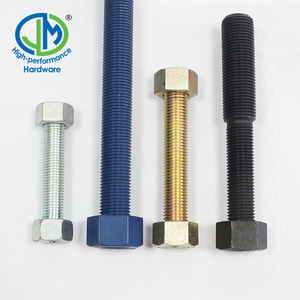
As a global premier manufacturer and exporter of ASTM A193 Grade B7, B7M, B16, and ASTM A320 Grade L7 stud bolts paired with ASTM A194 Grade 2H and 2HM heavy hex nuts, our engineering division implements state-of-the-art Xylan® (Whitford / PPG fluoropolymer) surface engineering technologies. This white paper outlines the metallurgical, mechanical, and tribological advantages of Xylan-coated bolting systems, providing procurement directors and corrosion engineers with actionable information gain for project specifications.
Xylan coatings lower the coefficient of friction (μ) down to 0.05 – 0.10. This dramatically minimizes energy lost to friction during tightening, converting up to 90% of applied torque directly into clamp load.
Formulated with composite resins, organic polymers, and lubricating solids, Xylan 1014 and 1070 coatings sustain over 1,500 to 3,000 hours of continuous salt spray exposure per ASTM B117 testing without red rust.
Eliminates cold welding and thread binding during assembly and maintenance. Allows effortless non-destructive breakout even after years of continuous high-temperature service up to +288°C (550°F).
In bolted joint engineering, the relationship between applied torque ($T$) and resulting bolt preload tension ($F$) is governed by the short-form equation $T = K \cdot D \cdot F$, where $K$ is the non-dimensional nut factor (torque coefficient), and $D$ is the nominal bolt diameter. For unlubricated plain carbon steel or hot-dip galvanized studs, the $K$-factor fluctuates wildly between 0.18 and 0.35 due to surface roughness variations, zinc flaking, and local micro-welding.
This wide scatter causes severe joint integrity risks: some bolts in a flange ring remain under-tensioned (causing fluid leaks), while adjacent bolts suffer over-tensioning (causing yield deformation or thread stripping). Xylan fluoropolymer coating standardizes the K-factor to a predictable range of 0.12 to 0.14 (±5%) across multi-bolt flange installations. This precise control ensures uniform gasket compression, preventing fugitive emissions in chemical processing plants.
Information Gain Insight: Applying Xylan coating directly onto bare metal without prior phosphate or ceramic sub-layer pretreatments reduces adhesion durability. At our manufacturing facility, all stud bolts undergo automated abrasive grit-blasting (Sa 2.5 finish) followed by zinc-phosphate micro-crystalline pretreatment before multi-coat electrostatic spraying and thermal curing at 230°C.
Direct technical comparison of protective finishes for ASTM A193 B7/B16 stud bolts and ASTM A194 heavy hex nuts under rigorous chemical and marine test standards.
| Coating / Finish Type | Typical Dry Film Thickness (DFT) | Friction Coeff (μ) | Salt Spray Resistance (ASTM B117) | Max Temp Limit | Acid & Alkali Resistance | Recommended Primary Environment |
|---|---|---|---|---|---|---|
| Xylan 1014 / 1424 (PTFE) | 20 – 25 μm | 0.08 – 0.12 | 1,500 – 3,000+ Hours | +288°C (550°F) | Excellent (pH 1–14) | Offshore Oil Platforms, Subsea, Chemical Piping |
| Xylan 1070 (Fluoropolymer) | 20 – 28 μm | 0.06 – 0.10 | 3,000+ Hours | +260°C (500°F) | Superior Acid Barrier | Refinery Marine Flanges, Desalination Plants |
| Hot-Dip Galvanized (HDG) | 45 – 65 μm | 0.20 – 0.28 | 500 – 800 Hours | +200°C (392°F) | Moderate / Poor Acids | Structural Steel, Highway Infrastructure |
| Electro-Zinc Plating (Cr3+) | 8 – 12 μm | 0.15 – 0.22 | 96 – 240 Hours | +120°C (248°F) | Poor Acid Resistance | Indoor Machinery, Mild Atmospheric Use |
| Cadmium Plating + Chromate | 12 – 15 μm | 0.12 – 0.16 | 1,000 Hours | +230°C (446°F) | Good Alkali Resistance | Aerospace (Restricted by RoHS / REACH) |
| Zinc-Nickel Electroplate | 10 – 15 μm | 0.14 – 0.18 | 1,000 – 1,500 Hours | +300°C (572°F) | Moderate Chemical | Automotive Engine, Hydraulic Flanges |
How evolving international environmental policies, offshore energy transition, and hydrogen safety standards are reshaping global fastener specifications.
Carbon Capture and Green Hydrogen distribution require fasteners resistant to hydrogen embrittlement. Demand is accelerating for vacuum-degassed ASTM A320 L7 and Inconel 718 studs with VOC-free Xylan formulations.
Global mandates are phasing out hexavalent chromium (Cr6+) and cadmium plateries. Modern Xylan coatings engineered by our team are 100% compliant with EU REACH, RoHS 3, and OSHA worker safety protocols.
Floating offshore wind turbines require continuous subsea fastener performance in C5-M marine splash zones. Double-barrier Xylan over zinc-nickel system is becoming standard specification for tower-to-substructure flanges.
Major EPC contractors now require heat-number laser engraving on every individual stud bolt. Optical emission spectrometry (OES) and Positive Material Identification (PMI) data are embedded directly into digital mill test certificates (EN 10204 3.1).
From raw material heat inspection in Mumbai to final seaworthy export packing, our quality control procedures strictly satisfy ASTM, ASME, DIN, ISO, and NACE standards.
We source prime round steel bars strictly from certified primary steel mills. Every heat undergoes spectro chemical analysis, ultrasonic flaw detection, and Charpy V-Notch impact testing down to -101°C for low-temperature ASTM A320 L7 alloys.
All stud threads are 100% cold thread rolled rather than cut. Thread rolling creates compressive residual surface stresses, increasing fatigue resistance by over 30% while producing smooth pitch diameters optimized for uniform coating adhesion.
Coating dry film thickness (DFT) is verified using digital magnetic thickness gauges across 100% of lots. Cross-hatch adhesion testing (ASTM D3359) and MEK rub resistance testing guarantee zero flaking under heavy torque loading.
In-depth answers to common engineering, procurement, and maintenance questions regarding Xylan-coated bolting products.
Partner with India’s foremost ISO-certified manufacturer and exporter. Send us your bill of materials, engineering drawings, or RFQ details for immediate technical review and competitive factory pricing.